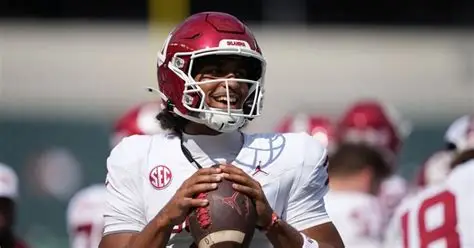
MORGANTOWN, West Virginia — There was a time when West Virginia could recruit a talented quarterback, develop him into a star, and reasonably expect to have him running the offense for the next several seasons. Those days are long gone. College football has become a business in which the best players can command millions of dollars, and if a school isn’t willing or able to pay what the market demands, somebody else probably will. That’s the reality facing Rich Rodriguez, Wren Baker, and the West Virginia athletic depHow Much Is Michael Hawkins Jr. Really Worth? West Virginia Could Be Facing a $5 Million Decision
artment as they attempt to keep Michael Hawkins Jr. in Morgantown for the 2027 season. And if the Mountaineers want to keep one of the most exciting quarterbacks in college football, they may have to make a financial commitment unlike anything this program has previously experienced.
As The Voice of Morgantown previously reported, sources have indicated that West Virginia and Michael Hawkins Jr. have reached an agreement for him to remain in Morgantown for the 2027 season. While the university has not publicly announced the details of any agreement, the expectation surrounding Hawkins’ future has created plenty of excitement among Mountaineer fans. But there’s another side to this story that deserves just as much attention: What would it actually cost West Virginia to keep a quarterback of Hawkins’ caliber? With the market for elite college quarterbacks reaching unprecedented levels, the financial commitment required to retain Hawkins could be far greater than many fans realize.
The answer might make some fans uncomfortable. Three million dollars? Four million? Five million? Those are staggering amounts of money for a college football player, particularly at a school that doesn’t have the financial resources of Texas, Ohio State, or some of the SEC’s wealthiest programs. But pretending those numbers are unrealistic doesn’t change the market. ESPN’s reporting on quarterback compensation has placed many Power Four starters in the $1 million to $3 million range, with the upper end reaching approximately $4 million to $5 million. Those figures don’t mean every productive quarterback automatically deserves a five-million-dollar deal, but they demonstrate just how expensive it has become to retain a player capable of changing the direction of a program.
And Hawkins has certainly demonstrated that kind of potential. Through eight games this season, the Oklahoma transfer has thrown for 1,598 yards and 11 touchdowns while rushing for another 836 yards and 16 scores. That’s 2,434 yards of total offense and 27 touchdowns accounted for in his first season running Rodriguez’s system. Against Cincinnati, Hawkins delivered one of the most spectacular performances by a West Virginia quarterback in recent memory, throwing for 464 yards and three touchdowns while adding 77 rushing yards and two more scores. Those are the kinds of performances that get the attention of opposing coaches, national analysts, and, perhaps most importantly in today’s college football environment, people with enough money to change a player’s future.
There’s another important distinction when evaluating Hawkins’ potential value. He’s not simply a quarterback putting up impressive numbers in an offense designed to make the position look good. His ability to create plays with his legs completely changes how opposing defenses have to prepare for West Virginia, and his development as a passer has made him increasingly dangerous. Rodriguez has built much of his coaching reputation around quarterbacks who can threaten defenses in multiple ways, and Hawkins appears to be an outstanding fit for that philosophy. When the Mountaineers are playing well offensively, opponents have to account for Cam Cook between the tackles, Hawkins on designed runs, and the possibility that Hawkins will pull up and throw the football downfield. That’s an extremely difficult combination to defend, and replacing the player who makes it all work would be far more complicated than simply finding another talented quarterback in the transfer portal.
Of course, Hawkins isn’t a finished product, and that matters when discussing his market value. His completion percentage, consistency as a passer, and decision-making still leave room for improvement. There have been games when his arm hasn’t been nearly as effective as his legs, and opposing defenses will continue adjusting to what Rodriguez wants to accomplish. But that’s also part of what makes his situation so intriguing. West Virginia wouldn’t simply be investing in what Hawkins has already accomplished. It would be investing in what he might become after another offseason working with Rodriguez, another year learning the offense, and another season developing chemistry with the players around him. If he can produce 27 touchdowns in eight games while still learning the system, it’s reasonable to wonder what his ceiling might look like with additional experience.
Public valuation estimates illustrate how uncertain the financial picture remains. The NIL Standard lists Hawkins’ estimated 2026 NIL valuation at approximately $1.67 million, while reporting from HailWV referenced an estimated current compensation figure of around $1.5 million discussed by EerSports reporters. Neither number establishes what Hawkins is actually being paid under a verified contract, and neither should be confused with what he could command in negotiations for 2027. A player’s estimated NIL value, his current compensation, and the amount another program might be willing to offer are three entirely different things. The last of those is ultimately what makes retaining an emerging star so difficult.
For that reason, I believe a range of approximately $3 million to $5 million is a reasonable scenario for West Virginia to prepare for, depending on how the quarterback market develops and what Hawkins accomplishes over the remainder of the season. That’s an editorial estimate, not a reported asking price or confirmed offer from the university. Three million dollars would already represent a substantial commitment. Four million would put Hawkins in a particularly expensive category of college quarterbacks. Five million would be an extraordinary investment for West Virginia, and one that would require the athletic department to carefully consider how much money remains available to build the rest of the roster.
That’s where this becomes a much more complicated conversation than simply telling Wren Baker to open the checkbook. West Virginia has significant needs beyond quarterback, particularly on defense, where the Mountaineers have struggled throughout much of the season. The offensive line needs continued development, talented receivers must be retained or recruited, and Rodriguez needs enough depth throughout the roster to compete with the Big 12’s better programs. Spending an enormous portion of the available player-compensation budget on one quarterback might make sense if that player can elevate everyone around him, but it also creates the risk of building a team that depends entirely too much on one individual.
Then again, what’s the alternative? Let Hawkins leave and hope Rodriguez can find somebody equally talented? That’s an awfully dangerous strategy for a program trying to establish momentum. West Virginia has already experienced enough instability in recent years, and losing its starting quarterback after a breakout season would create another enormous obstacle. Rodriguez would have to find a replacement, teach him the offense, develop chemistry with an entirely new group of players, and hope that the production Hawkins has provided could somehow be duplicated. None of that would be guaranteed, and even an expensive replacement wouldn’t necessarily deliver the same results.
There is also a legitimate argument that keeping Hawkins could help West Virginia recruit and retain other talented players. Wide receivers want to play with quarterbacks who can get them the football. Offensive linemen want to be part of productive offenses. Transfer portal prospects want to join programs that have a realistic opportunity to win meaningful games. Having Hawkins return would give Rodriguez an established offensive centerpiece and a much clearer recruiting pitch. Rather than selling players on what West Virginia might become, he could point to what Hawkins has already accomplished and explain how the Mountaineers intend to build around him.
The good news for West Virginia is that money may not be the only factor in Hawkins’ decision. Recent reporting has emphasized his relationship with Rodriguez, his comfort in the offense, and his desire to continue developing as a quarterback. Those things matter, particularly for a player with legitimate professional aspirations. Hawkins has already experienced college football at Oklahoma, and he knows that playing for a nationally recognized program doesn’t automatically guarantee the right opportunity. At West Virginia, he has a coach who believes in his abilities, an offensive system built around his strengths, and a fan base that has embraced him. Those advantages are valuable, even if nobody should expect him to ignore a dramatically better financial opportunity simply out of loyalty.
Ultimately, this is the kind of situation that will reveal how serious West Virginia is about competing in the modern era of college football. Rodriguez can recruit talented players and develop an exciting offense, but he cannot build a championship-caliber program if every breakout star becomes impossible to retain. Baker and the university’s supporters have to find a way to provide the resources necessary to compete without sacrificing the rest of the roster. That doesn’t mean blindly matching every number another program might offer. It means recognizing which players are truly capable of changing the trajectory of the program and making those players a priority.
Michael Hawkins Jr. is one of those players. He has already helped transform West Virginia’s offense, and his potential for continued improvement makes him one of the most important players Rodriguez could build around. Whether his eventual price is $3 million, $4 million, $5 million, or something entirely different remains to be seen. What shouldn’t be in question is how important he has become to West Virginia’s future.
Five million dollars for a college quarterback sounds outrageous until you consider what it might cost to lose him. The Mountaineers could spend years trying to find another player with Hawkins’ combination of athleticism, production, and fit within Rodriguez’s offense, and there’s no guarantee they’d succeed. If West Virginia truly believes it can compete for Big 12 championships with Hawkins leading the way, the university needs to be prepared for a serious financial commitment. The quarterback market isn’t waiting for the Mountaineers to catch up, and the schools with the deepest pockets certainly aren’t going to make things easier.
West Virginia finally has a quarterback who gives fans a reason to believe something special might be possible again. Keeping him won’t be cheap. But losing him could prove even more expensive.